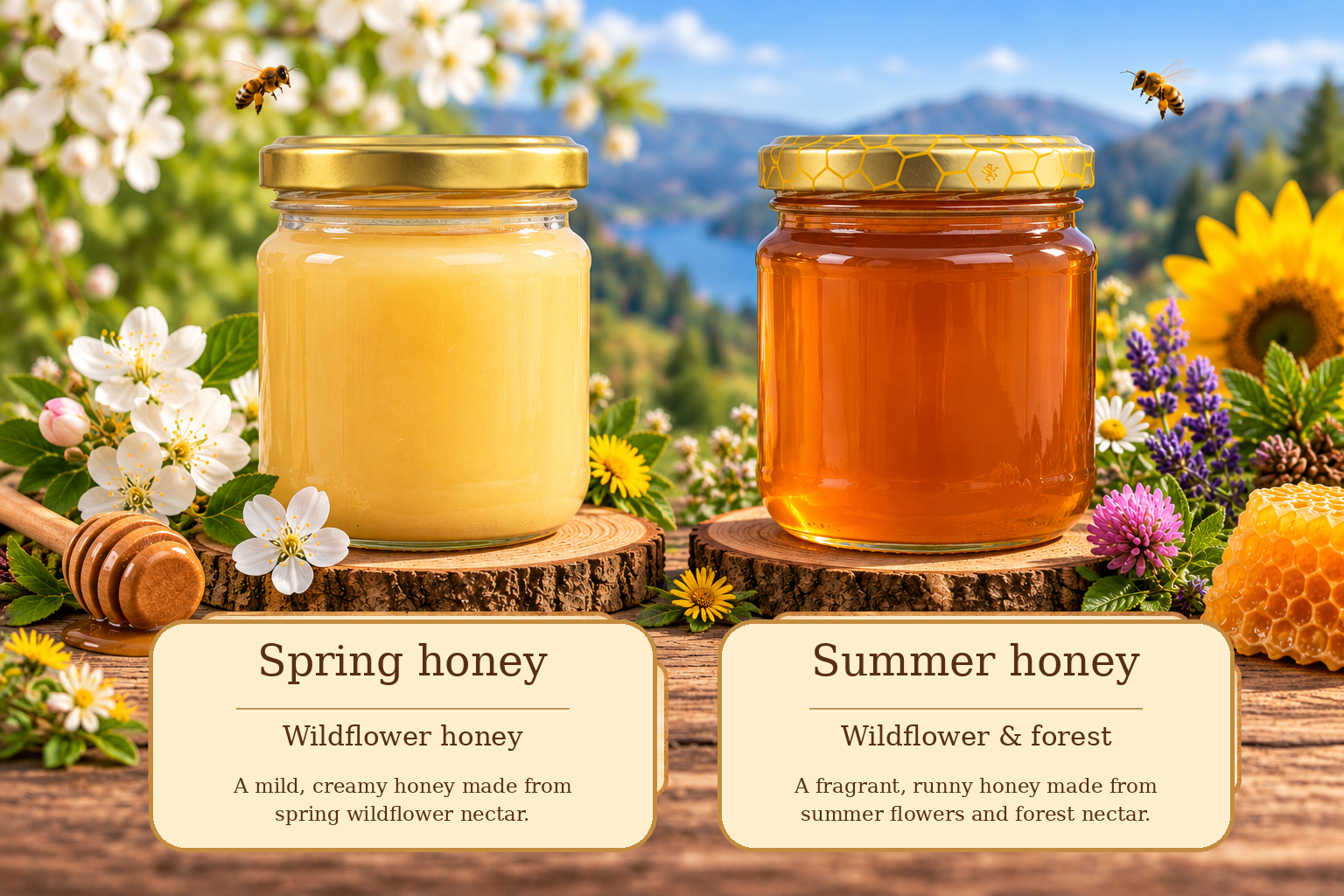
Two seasons, two distinct characters: the flowers visited by bees shape honey’s colour, aroma and texture.
Illustrative presentation of our spring wildflower honey and summer wildflower and forest honey.
Spring honey — Wildflower
In spring, bees gather nectar from fruit trees, maples, willows, dandelions and oilseed rape where grown. Honey with more glucose tends to crystallise sooner: its crystals scatter light, often giving it a creamy or almost white appearance. Crystal size also affects texture.
Summer honey — Wildflower and forest
In summer, bees visit lime trees, brambles, clovers, meadow flowers and sometimes sweet chestnuts. Depending on the season, they may also collect honeydew from trees. Honey relatively richer in fructose generally stays runny longer; floral sources and honeydew can produce amber to brown colours. It can still crystallise over time.
Flowering periods and forage plants
Spring
Plant
Typical flowering
Resource
🌳 Willow
February–April
Nectar and pollen
🌸 Fruit trees (cherry, apple)
March–May
Nectar and pollen
🌳 Maple
March–May
Nectar and pollen
🌼 Dandelion
March–May
Nectar and pollen
🌼 Oilseed rape (where grown)
April–May
Nectar and pollen
Summer
Plant
Typical flowering
Resource
🌳 Lime tree
June–July
Nectar
🌿 Bramble
June–August
Nectar and pollen
🌸 Clovers
May–September
Nectar and pollen
🌳 Sweet chestnut
June–July
Nectar and pollen
🌻 Meadow flowers
May–September
Nectar and pollen
🌳 Honeydew-producing trees
Summer, variable
Honeydew
Nectar sugars and crystallisation
Flower nectar contains varying amounts of sucrose, glucose and fructose. Bees use enzymes to break down much of the sucrose into glucose and fructose. The glucose-to-fructose balance strongly affects crystallisation: glucose promotes crystals, while fructose tends to keep honey liquid. Colour depends mainly on botanical origin and other compounds, not just sugar.
These colours and textures are typical tendencies, not guarantees: every harvest depends on weather, flowering and the blend of nectar sources.