Honey bees face both parasites and predators. Varroa mites, Asian hornets and European hornets differ in origin, biology and their effects on colonies.
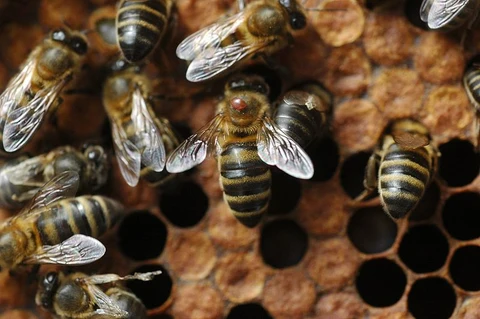
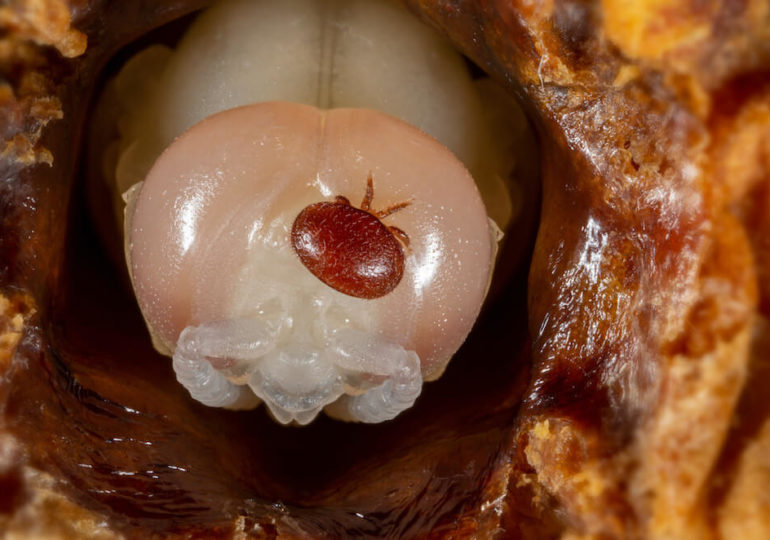
Varroa destructor is a tiny, flattened, reddish-brown mite; adult females are approximately 1–1.5 mm long. Originally associated with the Asian honey bee Apis cerana, it switched to the western honey bee Apis mellifera during the twentieth century and spread through bee movements and beekeeping trade.
Varroa primarily feeds on the fat-body tissue of adult and developing bees. A female enters a brood cell shortly before it is capped and lays several eggs. The first usually becomes a male and subsequent eggs become females. Mating occurs inside the sealed cell. When the bee emerges, the mother and mature mated daughters can leave and infest other bees.
Drone brood is especially suitable because it stays capped longer. On average, a mite may produce around 1–2 mated daughters in a worker cell versus 2–3 in a drone cell. These are variable averages, not fixed numbers.
Varroa weakens bees, shortens their lifespan and spreads viruses, including those associated with deformed wings. Heavy infestation in late summer can prevent healthy winter bees from developing, threatening the colony's survival. Beekeepers monitor mite levels and use locally approved control methods when necessary.
In Switzerland, varroa control follows the Swiss Bee Health Service (SSA) programme: monitor infestation regularly, intervene at the appropriate time, and use only authorised products in accordance with their official instructions. The aim is to protect bees, especially winter bees, while safeguarding honey quality.
Summer treatments with formic acid are generally carried out after honey supers have been removed. Formic acid can also affect mites reproducing in sealed brood. Authorised examples include Formivar and Formicpro. Use depends on temperature, colony strength and the specific product instructions.
Certain thymol products, including Thymovar and Api Life Var, are authorised. The SSA and Swiss Bee Research Centre recommend them mainly for low infestation levels. Their effectiveness depends on temperature and following the product protocol.
Supplementary winter treatment with oxalic acid is particularly effective when the colony is brood-free. Authorised preparations include Api-Bioxal, Oxuvar 5.7% and Varroxal. Permitted application methods and frequency depend on the label; repeated off-label applications should be avoided.
The Swiss list also includes flumethrin-based Bayvarol, but the SSA and Swiss Bee Research Centre do not recommend it. Amitraz-based varroa products are not authorised in Switzerland. Do not use homemade mixtures or unapproved veterinary medicines.
Important: do not use the treatments described here during the honey flow; remove honey supers before treating, and always follow the current official instructions for the exact product. Severe infestations require measures consistent with SSA guidance. Veterinary medicine use must be recorded. Dosages, temperatures and waiting periods differ by product: this article is not a product label.